
The Current Chippewa County Owner Record
The Catalis guest portal is the county source for tax parcel data in Chippewa County. Parcel-card labels vary from screen to screen. Treat any field list as a guide, not a promise that every label appears on every card. The tax account names an owner of record. That name is tied to the roll entry. It is not automatically the newest grantee on a recorded deed.
| Owner or taxpayer | Name shown on the current tax roll, if displayed |
|---|---|
| Mailing address | Tax notice destination, which may differ from the property |
| Situs address | Physical location of the parcel, if one is assigned |
| Municipality / tax district | Jurisdiction used to identify the local account |
| Deed reference | Recorded document to verify separately in the deed index |
| Last transfer date | Use the deed date; the tax card’s live field is not verified |
The tax-mailing address is not the situs. Neither field tells you who occupies the property. A trust, an estate, or a company can be the named owner, so keep the owner entry attached to its parcel number and legal description.
Chippewa County Owner-Record Access
The terms come first. Guest access to the county's Catalis portal opens after you accept them. Search options are broad. The portal takes a parcel number, an owner's first and last name, or a house number with street name. Use less text if a search finds nothing. Exact value, exemption, last-sale, and history fields need a live parcel session, and the Chippewa County Catalis guest portal is the public entry point for that session.
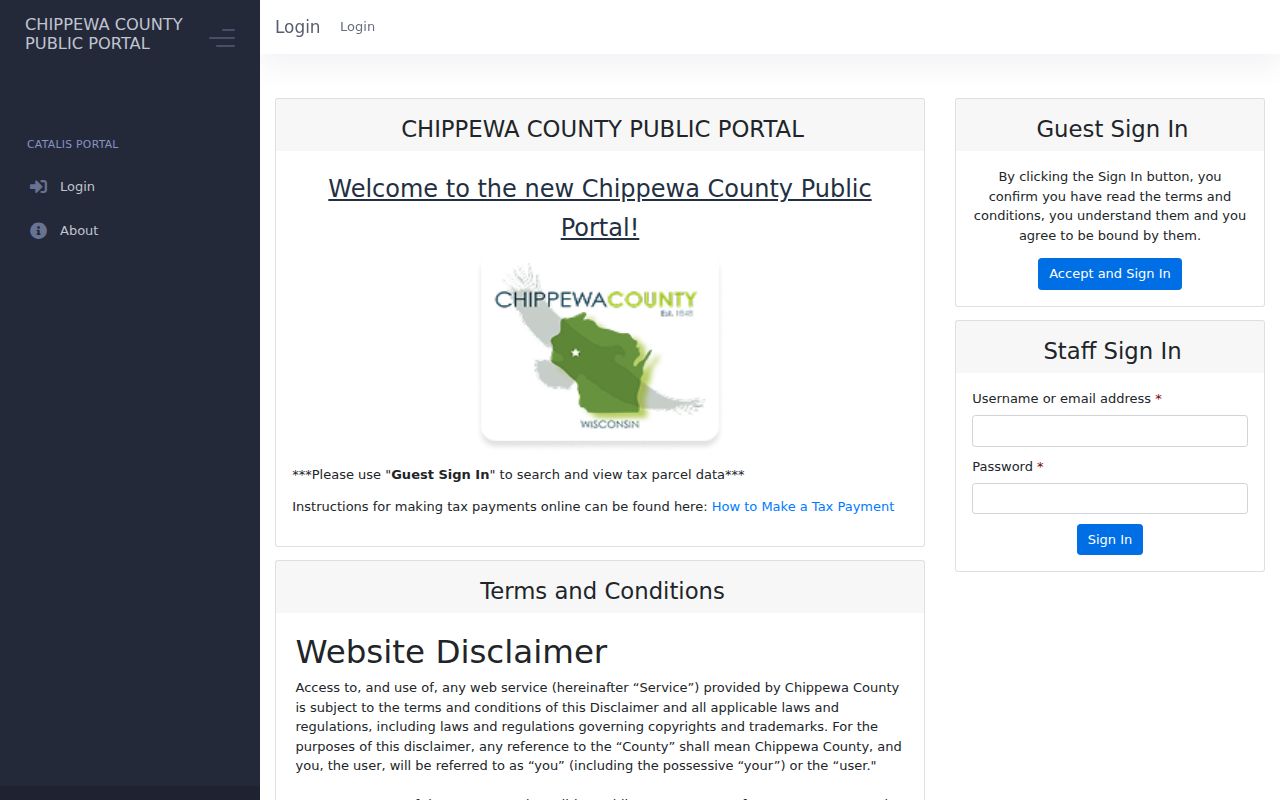
The image shows the public sign-in screen only. The owner-of-record parcel card and the recent transfer field sit behind that login.
Confirm a Current Chippewa Owner
A current-owner check compares the tax-roll name with the newest recorded deed. It checks the present record only. The Register of Deeds index searches by name, description, or document number. Its working index is not a guarantee of completeness.
- Read the owner or taxpayer name on the Catalis parcel record and note the date checked.
- Use the parcel’s legal description or owner name to find the newest deed.
- Compare the grantee, document date, parcel, and legal description with the tax record.
- If the names differ, call the Treasurer or Register of Deeds and ask which record is newer.
- Owner of record
- The party named in the tax roll or recorded deed being reviewed.
- Situs
- The physical parcel location, distinct from a tax mailing address.
- Recording lag
- The time between a recorded transfer and a later roll update; Chippewa County publishes no fixed number.
Tax-Roll Owner Versus Recorded Grantee
A tax account names one owner. A deed names its grantee, and the two records play different roles. The tax portal locates the parcel fastest. The Register of Deeds holds the recorded conveyance. A recently recorded deed may carry a newer ownership clue than the tax roll shows. No county source gives a set number of days for that roll update. This timing gap appears after many transfers and does not mean either record is wrong.
A mismatch calls for a check, not an assumption that one record is wrong. Compare the legal description and the document date. Then contact the office that holds the record. The latest recorded instrument does not replace a title search when legal reliance matters. Write down both dates. One is the recording date on the deed. The other is the date you accessed the tax account. A tax bill or portal entry may lag. It can reflect an earlier roll cycle even after an instrument is indexed. The legal description may match, but the names differ. Ask the Register of Deeds whether a later instrument appears. Ask the Treasurer whether the account was updated.
The Chippewa County deed record route explains the index and document-image layers.
Chippewa Situs and Mailing Addresses
The situs address shows where the property sits. The mailing address shows where a tax notice goes. They can differ for a nonresident owner, a trust, a company, or an estate. A mailing location is not the land itself. The person named on the bill may not live at the situs. Municipality codes and tax districts tighten the match. Bloomer city is code 206/CBL, while Town Bloomer is 010/TBL, and Stanley is a partial-county municipality. At those edges, check the GIS boundary before calling a record the current owner of land in Chippewa County.
Entity Names on a Chippewa Parcel
A tax-roll name can be an LLC, a trust, or an estate rather than a person. The state DFI Corporate Records Search can confirm an entity's legal name, status, registered office, agent, and filing history. An agent is a contact. That agent does not own the real estate by default. The recorded deed is the place to confirm the grantee tied to the parcel.
Probate questions go to the Chippewa County Register in Probate, Room 203 of the courthouse, phone 715-726-7737. WCCA may show a case summary. The full file sits with the custodian. Ask the custodian about copying rules.
Use the state's DFI Corporate Records Search as an entity cross-check, not a land-title source.
Protecting a Chippewa County Owner Record
Chippewa County offers a free Property Fraud Alert service. An owner registers a name. The owner gets notified when that name shows up in a county recording. It is a useful early warning. It cannot block a recording, though. And it will not catch every spelling variation of a name. If a notice arrives, pull the document number and image from the Register of Deeds. See what was actually filed.
Wisconsin's Safe at Home program works differently. It assigns qualifying participants a substitute address. The real one stays protected under program rules. Never try to identify or publish a protected address. When a specific record raises a concern, the custodian can explain how the program applies.
Chippewa County Property Fraud Alert service registration is handled at the official sign-up page.
Record the Current-Owner Check Date
Write down what the lookup showed. Save the parcel number, the portal used, the date, the owner label exactly as displayed, the situs, the mailing address, the municipality, the tax district, the legal description, and the newest deed number with its recording date. Note any field the screen left blank. That snapshot makes clear what was current when you checked.
A mismatch needs the right office. If the owner name disagrees with the newest deed, call the Treasurer at 715-726-7960 about the tax account or the Register of Deeds at 715-726-7994 about recorded documents. The general Chippewa County owner-finding method starts with the address and follows the parcel to the correct office.
Entities and trusts take extra care. For an LLC or corporation, keep the exact grantee name and use Wisconsin DFI only to confirm the entity's identity, status, and agent. The agent is not automatically the parcel owner. For a trust or estate, the deed's fiduciary language may show who signed, and the probate custodian can point to any public estate file. These steps clarify record roles. They do not turn a tax roll lookup into a title opinion.
When the tax roll and deed still disagree, compare dates and legal descriptions first. Then ask the custodian to identify the newest instrument tied to the account and whether a later roll update is pending. Give the office the parcel number and recording document number, not just a street address. Keep the answer with your check date. No portal or index publishes a fixed update interval that would explain a mismatch on its own.
A recent transfer may be more than a simple sale. A personal-representative deed, a transfer-on-death instrument, a correction deed, or a conveyance into a trust can change the recorded grantee while the tax account still carries an earlier name. Look at the instrument type and the legal description before deciding. The difference may be an update lag, a partial interest, or an entirely different parcel.
Limits of the Current Owner Record
The current owner in a tax or deed record is not always the person living at the property. A mailing address can differ from the situs, and an entity's registered agent is not automatically its owner. Public records assign specific record roles; they never replace a title search.
Lawful use. Use Chippewa County owner records for property diligence and lawful civic purposes. Do not use an owner name or address to stalk, harass, threaten, or harm anyone.