
Chippewa County Property Value Types
Several different numbers can carry the label “value” on a Chippewa County property record. Wisconsin’s Department of Revenue splits them into assessed value. Assessed value is an estimated fair market value derived through an assessment ratio. Equalized value serves a different purpose. It is used for comparisons across jurisdictions. Sale consideration, meanwhile, is simply the amount recorded with an instrument. Before comparing any two figures, check which field and which year you are reading.
| Value | What It Is | Where |
|---|---|---|
| Assessed value | Local value used in the assessment system | Municipal assessor / tax roll |
| Estimated fair market value | Assessed value divided by the taxation district’s average ratio, with rounding | Wisconsin tax bill, if shown |
| Equalized value | DOR comparison and apportionment measure for a municipality or district | DOR statistical reports |
| Sale consideration | Transaction amount or consideration recorded with a transfer; may be nominal or unavailable | Recorded deed / transfer trail |
The assessment date is January 1 of the assessment year. A later sale does not reset every parcel value. A reported consideration may not reflect an arm's-length sale. Equalized value belongs to the taxing jurisdiction rather than to one parcel. For tax-bill or appeal questions, see the Chippewa County property tax records page.
Chippewa County Assessment Ratios
Wisconsin DOR defines the assessment ratio as assessed value divided by current market value. A tax bill’s estimated fair market value comes from dividing the assessed value by the taxation district’s average assessment ratio. The required rounding is applied after that division. The result is a system estimate for the assessment year. It is not an appraisal promise. The county publishes no single ratio that fits every property in Chippewa County. Use the DOR report for the municipality or tax district listed on the parcel. An average ratio describes a whole group of usable sales and assessments. An individual home or farm may sit above or below it. See the Wisconsin DOR assessment-ratio reports for municipal comparisons. For example only, imagine a parcel with an assessed value of $180,000. Give it a district ratio of 90 percent. Simple division would produce an estimated fair market figure near $200,000 before required rounding. Those are hypothetical inputs, not Chippewa County values. Always use the ratio for the assessment year and tax district printed on the parcel account. Never use an estimate from a neighboring municipality.
Look Up a Chippewa County Property Value
Start with the parcel number when it is known. The Catalis public portal supports address, owner, and parcel searches for Chippewa County tax accounts. Use it to select the right account. Then confirm which values and which assessment year the portal actually displays. The value card may not show a number at all. In that case, ask the municipal assessor. Do not infer a value from a nearby parcel.
- Search Catalis as a guest by parcel/property number, owner, or house number and street name.
- Confirm the parcel, municipality, tax district, and legal description.
- Copy the assessed value and year exactly as shown; mark any market estimate as a separate field.
- Use DOR’s ratio for the correct district when interpreting a tax-bill estimate.
- Check the recorded transfer for consideration, while noting that it may not be a market sale.
- Assessed value
- The municipality’s assessment figure for tax use.
- Market value
- A current value concept; the tax-bill estimate uses a district ratio.
- Assessment ratio
- Assessed value divided by current market value.
- Sale consideration
- The recorded transaction amount, which can differ from market value.
January 1 Chippewa Assessment Date
Every Wisconsin assessment is pegged to January 1 of its assessment year. Chippewa County parcel values are snapshots, not live quotes. Market activity after that date does not move the number. A home sold in spring may still carry a value set months earlier. Municipal revaluation schedules also differ across the county. So two neighboring parcels can reflect very different valuation years.
No countywide revaluation cycle applies here. Chippewa County assessors work jurisdiction by jurisdiction. Do not guess a valuation date from a population shift. Do not guess one from what a neighboring town did. The local assessor can tell you which year and valuation basis your parcel record uses.
Chippewa County Equalized Value Context
The Department of Revenue publishes equalized values for a reason. They let municipalities compare and apportion total value fairly. The reports can also break out tax-incremental-district figures, net new construction, and class-level compliance. But the tool works at the jurisdiction level. No single Chippewa County parcel gets an equalized price assigned to it. An owner should never set an equalized total beside one sale price as if they were peers.
To use these figures correctly, find the report for your parcel's municipality or tax district. Then weigh that measure against the parcel's assessed record and any relevant sales. The DOR timetable runs through preliminary and final publications. So match the report to the year you care about.
Equalized totals shine at the community level. They can show how one municipality's tax base stacks up against another's. They can also show how value gets apportioned across jurisdictions. They cannot tell you whether a building is sound. They cannot tell you whether improvements are quality work. They cannot tell you whether an asking price is fair. For one parcel, keep equalized value in a community-level column. Keep the assessed figure, assessment year, and recorded sale in columns of their own.
Sale Price in the Chippewa Deed Trail
A recorded deed trail may list consideration. The number can mislead, though. Sometimes it is nominal, exempt, or missing from the public parcel card entirely. Other times it reflects a transfer that never touched the open market. Whatever the figure shows, it is evidence about that one transaction. It is not a guaranteed value for the current owner of record. The deed's parties and legal description carry just as much weight as the amount.
Consider a recent Chippewa County transfer. Set the consideration beside the date, the property's condition, parcel size, and district. One transaction should never become the going price for a whole block. To locate the instrument tied to a parcel, start with the Chippewa County deed index.
Land and Improvement Fields in Chippewa
Chippewa County's Catalis result card shows the land, improvement, and total value fields. They appear where they are configured. Exact labels vary. Copy whatever fields are visible and note the source date. Never fill in a missing building value from a commercial estimate. Do not take it from an adjacent parcel either.
An error in a land or improvement record belongs to the municipal assessor. Bill and payment questions go to the Treasurer. Keep three sources straight: the tax account, the assessment, and the recorded deed. They are separate records. Each answers a different question about the parcel.
Chippewa County’s Value Portal Entry
Catalis is Chippewa County's public tax parcel portal. A guest user accepts the terms and then searches by parcel number. An owner name or address works too. The county's own advice is that entering less returns more. Payment transactions are capped at ten parcels. The sign-in page itself shows no value history or parcel result. The Catalis public portal is where a Chippewa County property value lookup begins.
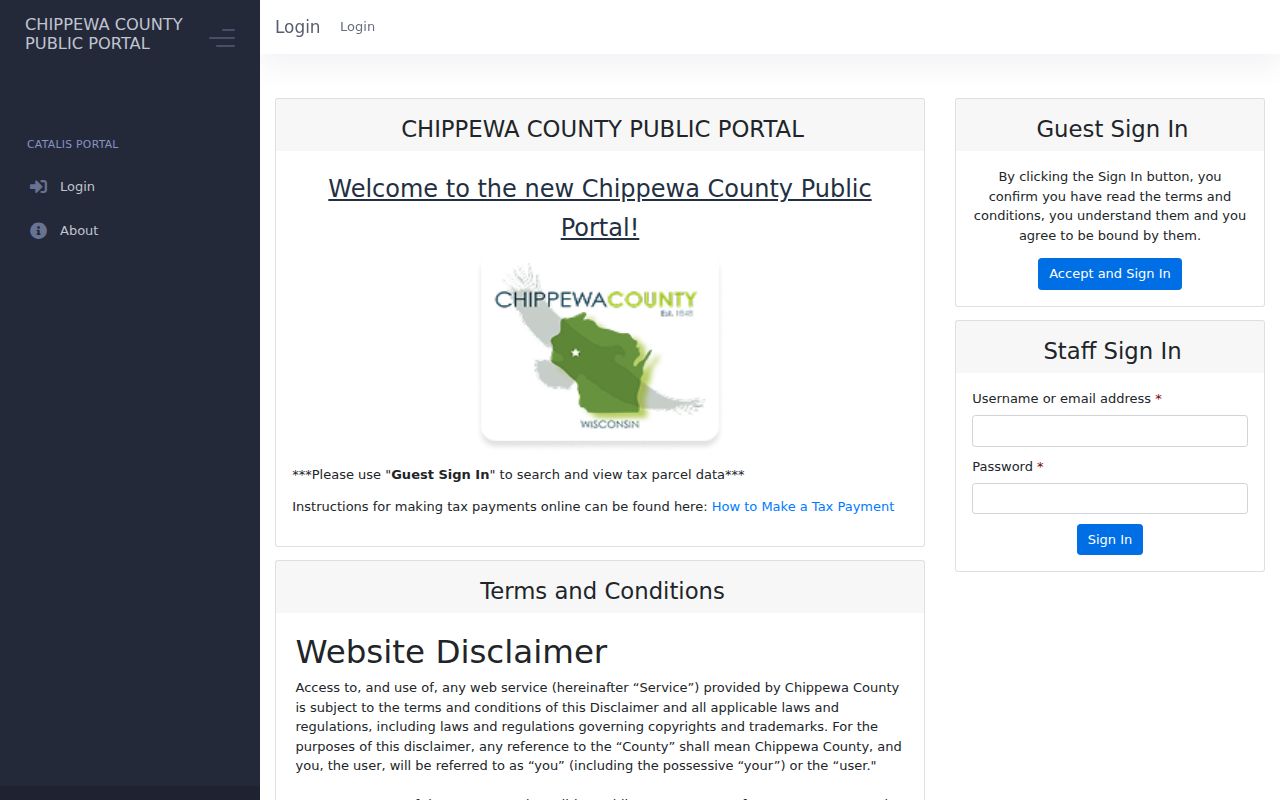
The login page is only an entry point. Open the live parcel record for the actual assessed value and assessment year.
Limits of a Chippewa County Value
An assessed figure exists to support the tax system. A DOR market estimate applies an average ratio for the whole taxation district. Equalized value lets communities be compared, and recorded consideration describes one transaction. None of these guarantees what a specific property would sell for today. A licensed appraiser provides an appraisal for a sale or a loan. The assessor's number serves a different purpose.
Before comparing a neighbor's figure with the subject parcel, confirm the municipality and assessment year on both accounts. Then determine whether each number is an assessed value, an estimated market value, an equalized value, or sale consideration. When a record splits land and improvements, keep both parts plus the total exactly as printed. For an objection, get the notice and deadline from the municipality. Chippewa County publishes no single countywide hearing calendar or appeal date.
For a review meeting, gather the assessment notice. Bring the parcel's land and improvement details, photographs of relevant condition, and recent comparable sales similar in location and property type. List any factual error in the parcel description separately from any argument about value. The municipal assessor explains the local record; the Treasurer explains a bill or payment. Keep a copy of every submission and the date it was delivered.
Value vs price. A Chippewa County assessment is not a promised sale price or appraisal. Compare it with current, relevant market evidence and the correct municipal ratio.