
Tracing Former Owners in Chippewa County
Every prior owner emerges from the same pattern. Find the grantee on one deed. Then hunt for that same party as the grantor on the transfer before it. Keep the date, both roles, document type, legal description, and county reference number side by side in your notes. Resist the urge to fill a gap with a name that merely resembles the person or company on the parcel. A worksheet format keeps the backward chain tied to its source record. Copy names and dates straight from the deed image. Invented details help no one.
| Transfer record | Date to note | Grantor → Grantee | Document reference |
|---|---|---|---|
| Newest deed | Copy from instrument | Copy the named parties | Document number and legal description |
| Prior deed | Copy from instrument | Search the prior owner’s role | Match parcel and description |
| Older index block | Year range in the code | Use the right surname initial | Historic document number |
| Plat or CSM | Recording date | Match subdivision or parent tract | Volume, page, document number |
Transfers after December 1, 1953 belong to the tract index. Earlier owners take a different route. Open the historical grantor and grantee instructions. Locate a document number, then open the image. When a chain crosses an estate or a parcel split, the trail calls for more records. Add the probate file, plat, or CSM.
Chippewa County’s 1953 Index Cutoff
The Register of Deeds tract index begins on December 1, 1953. It covers certified survey maps and plat maps. It also covers several deed-volume groups and miscellaneous volumes 34 through 39. The county says more deed and miscellaneous volumes have been indexed too. The online tract index remains a working copy, though, not a promise of a complete chain.
Older images reach back to 1854. They are filed by document number only. A researcher needs the historical index block first. Then the image system can be asked for a specific old instrument. A modern address search alone will not bridge that gap. The Register of Deeds coverage page spells out the tract cutoff and older image access.
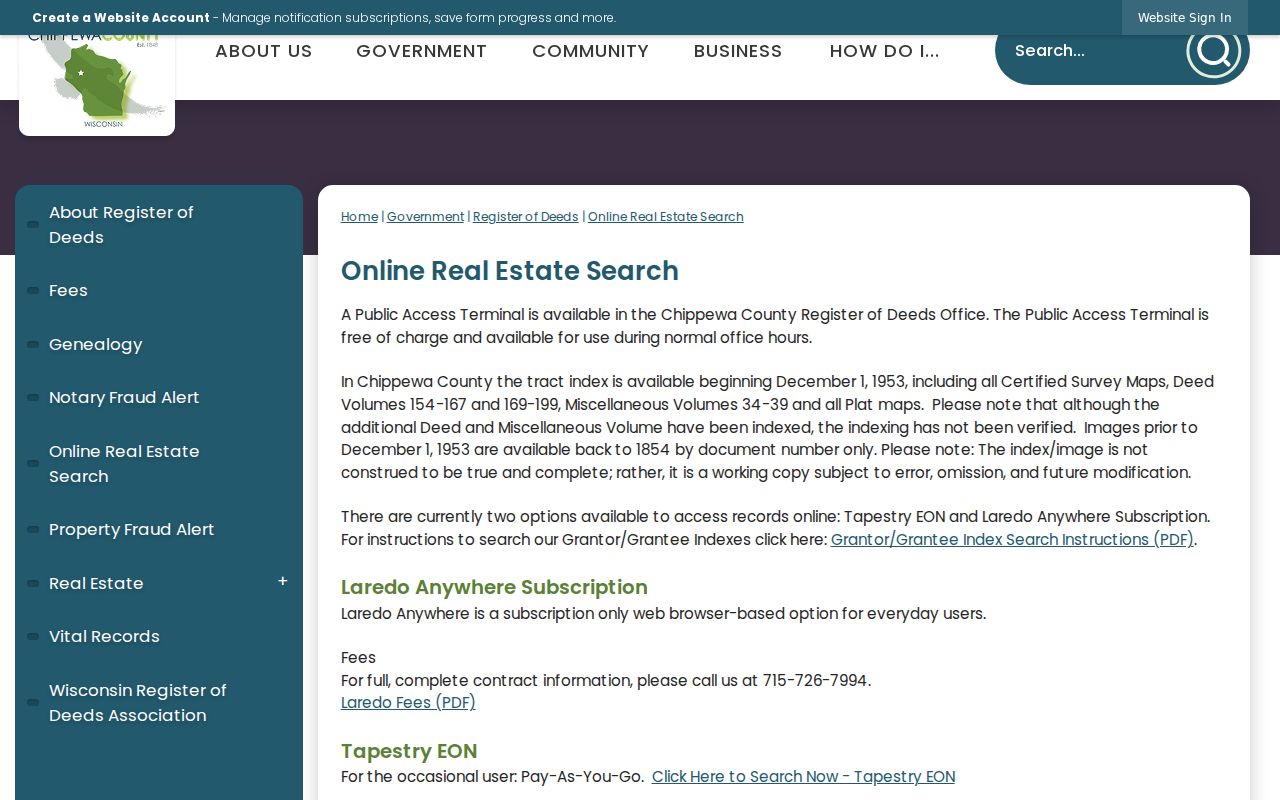
Check the county page first. It tells you whether the next step is a modern tract search or a document-number search.
Walk the Chippewa Deed Chain Backward
Begin with the most recent deed on the parcel. Search that prior party under the correct grantor or grantee role. The legal description is the control at each step. A prior owner may have conveyed only part of a tract, or the parcel may have shifted through a CSM or condominium plat. A name match alone is never enough.
- Find the newest deed and copy its date, parties, document number, and full legal description.
- Search the grantee’s earlier acquisition and compare the tract description.
- Use the prior grantor as the next name to trace backward.
- When the deed points to a plat or CSM, pull that recorded map and confirm the child parcel.
- Before December 1953, find the historical block code and document number before seeking an image.
- Grantor
- The party conveying an interest in an instrument.
- Grantee
- The party receiving an interest in an instrument.
- Chain of title
- The sequence of recorded transfers for the same land.
- Reverse index
- A search path that uses a prior party’s role to move backward to an earlier instrument.
Chippewa GRIDX and GEIDX Blocks
Historic Tapestry searches run through INDEX - GRANTOR or INDEX - GRANTEE. The county's codes look like GRIDX1950-51-A and GEIDX1899-1902-S. The year span is hyphenated. The final letter marks the surname initial. Note that the 1856 grantor block is a mortgage index, a useful clue when an early search turns up an instrument that is not a deed.
Some historic blocks lack entries for certain initials. The county flags gaps for X and some older Q, Y, and U ranges. Tapestry cannot sort the historical index. Laredo can sort document numbers into year order. A blank block is not proof that no prior owner or mortgage existed.
When you follow an old chain, record the index role, surname initial, year span, and document number exactly as shown. GRIDX marks a grantor block and GEIDX a grantee block. Reverse the roles and an instrument can vanish from view. The old blocks are keyed by party rather than modern street address, so the latest deed's grantor and legal description often bridge you to the right year range. Read the county's grantor-grantee instructions before building a search pattern. The Tapestry EON interface is the remote search route.
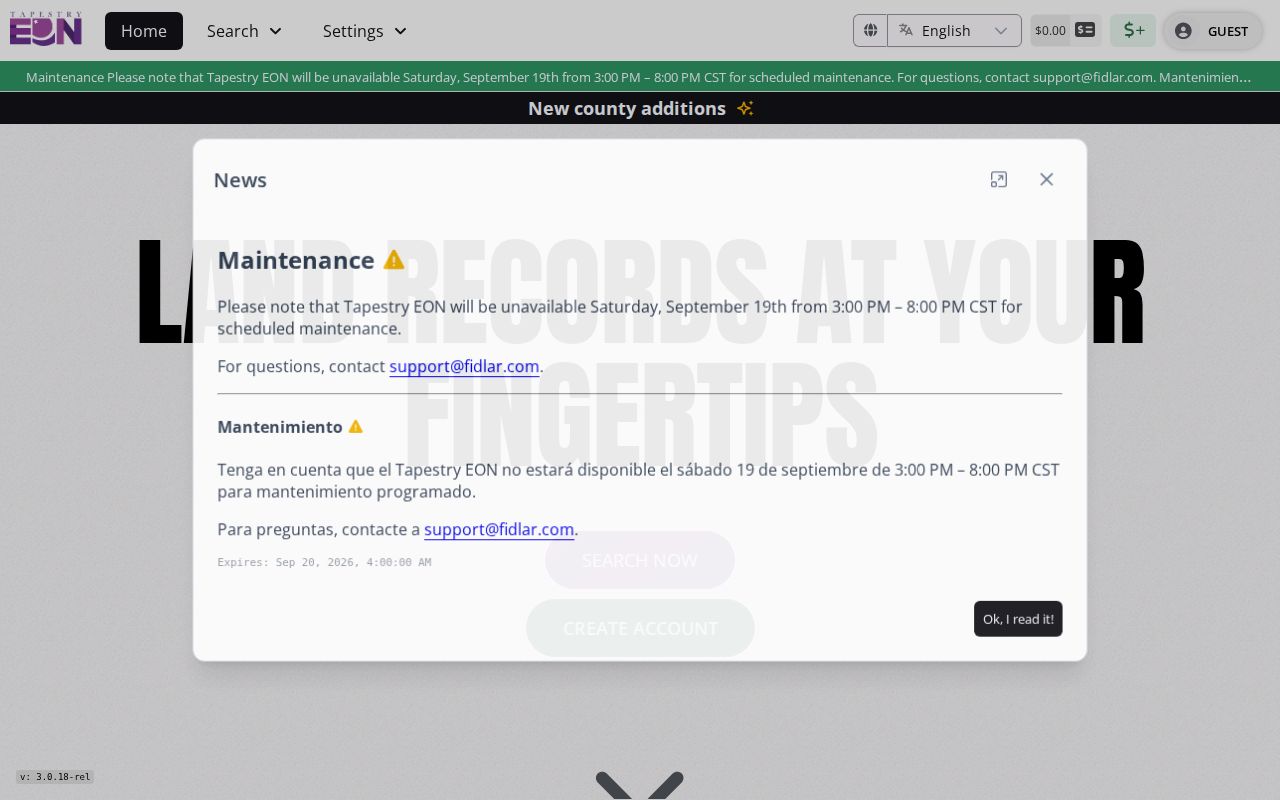
One index query can return a pile of entries. Record the year block and document number before opening an image.
Chippewa Plat and CSM Chain Links
A legal description built on lot and block points toward a recorded plat. The county's 28-page reference lists plat names, volume, page, document number, and short codes. Search punctuation-free names where the reference directs. Test word-order changes and try dropping parenthetical notes. Merged or removed condominium phases can also explain this. The old deed may differ from the current parcel card.
A CSM can carve a child parcel out of a larger parent tract. Follow the parent deed and the CSM number to keep former-owner records connected. For a condo, pull the declaration and the unit deed too. A historic instrument may not carry the current street address. The legal description is often the better bridge.
Estate Transfers in a Chippewa Chain
A death can interrupt a simple seller-to-buyer chain in Chippewa County. Several documents explain the break. A personal representative may sign a deed. A probate order may authorize a sale, or a transfer-on-death instrument may appear in the property records. A probate case can name heirs or fiduciaries before they show up as grantees. One caution matters here. The death certificate is context, not a land transfer instrument.
The Register in Probate sits in Room 203 at 711 N Bridge Street, phone 715-726-7737. WCCA may show a public case summary. The full estate file comes from the custodian. Ask for the estate inventory, the order for sale, and the personal-representative or transfer document linking the parcel to its next owner.
The probate file shows authority. Confirm the deed separately. The resulting land instrument still needs checking in the Register of Deeds index. An heir in a court case is not automatically the owner of record for that parcel, so compare the probate order, fiduciary deed, document number, and legal description in sequence, and account for any later deed that changed the grantee.
Chippewa County Historic Roll Scanning
Chippewa County's 2025–2027 Land Information Plan lists historic tax-roll scanning, land-record scanning, and geographic document indexing as active projects. That proves old records matter to the county. It does not prove every roll is online. Ask Land Records which years or images exist today.
The Wisconsin Historical Society holds a 1912 plat of Chippewa Falls mapping lots, blocks, streets, railroads, parks, and city limits. It is dated, though. The plat is not a present-day owner list. It shines when an older deed cites a lot or street reference that no longer matches a current address.
Free Chippewa County Deed Terminal
The Register of Deeds offers a free public-access terminal. Remote access is different. Tapestry charges $8.95 plus tax per search, returns up to 300 listings, and bills extra for printed image pages. Laredo runs on subscription. During normal hours, a counter visit helps when the old surname block is unclear or a paid remote query finds nothing.
Call 715-726-7994 to confirm access and copy terms. The county posts no general certified deed-copy price on its online real-estate search page, so never confuse an index fee with a certified copy charge.
How Far Chippewa County Records Reach
Chippewa County property records run remarkably deep. Images reach back to 1854 by document number. The historical index instructions include blocks beginning in 1856. The tract index starts in 1953. The county publishes no report of a courthouse fire or a year-by-year library directory inventory. Never assume an unexplained gap came from a loss.
For a chain older than the online tract index, follow the documented index patterns and ask the Register of Deeds for help. It may cite a plat, a CSM, or probate. Add that record to the trail rather than forcing the history into a simple run of purchase deeds.
Lawful use. Former-owner records support house history, title research, and property diligence. Do not use a historic name or address to track, harass, threaten, or harm any living person.