
Chippewa County Deed Records and Transfers
Every deed names two key parties. The grantor conveys an interest in the land, and the grantee receives it. The Chippewa County Register of Deeds records these transfers alongside other land instruments. That distinction matters. A deed records a change of ownership. A mortgage, easement, lien, or release can shape what happens to the parcel. It is not a deed at all. When you pull a Chippewa County deed record, read the full legal description and both party names. Do not rely on the label attached to the search result.
| Deed Type | What It Does | Common Use |
|---|---|---|
| Recorded deed | Names parties and describes a transfer of an interest | Confirm a conveyance or legal description |
| Personal-representative deed | Can carry property from an estate under fiduciary authority | Trace a death-related transfer with probate context |
| Transfer-on-death instrument | May form part of a transfer at death | Check the instrument and any later deed |
| Tax deed or tax-related instrument | Relates to a tax-deed process or land disposition | Cross-check Treasurer and court records |
| Mortgage, lien, easement, or release | Records an encumbrance, right, or discharge | Review interests tied to a parcel |
The Chippewa County index reaches beyond deeds alone. It also lists mortgages, easements, liens, certified survey maps, and plats. A lender can show up as a mortgagee. It never holds fee ownership, and a release or satisfaction may follow the mortgage later. Search both directions of a transaction. Then compare every document against the parcel's legal description so the chain holds together.
Chippewa County’s 1953 Tract Index
The county's tract index opens on December 1, 1953. Its coverage includes all certified survey maps and every plat map. It also spans deed volumes 154 through 167 and 169 through 199, plus miscellaneous volumes 34 through 39. The county notes that other deed and miscellaneous volumes may be indexed. That work has not been confirmed. Treat the tract index as a working copy. It can carry errors, omissions, or later changes.
The Register of Deeds lays out this coverage and the ways to search it. Open the Chippewa County deed search page before driving to the courthouse. It may also beat paying for an online service.
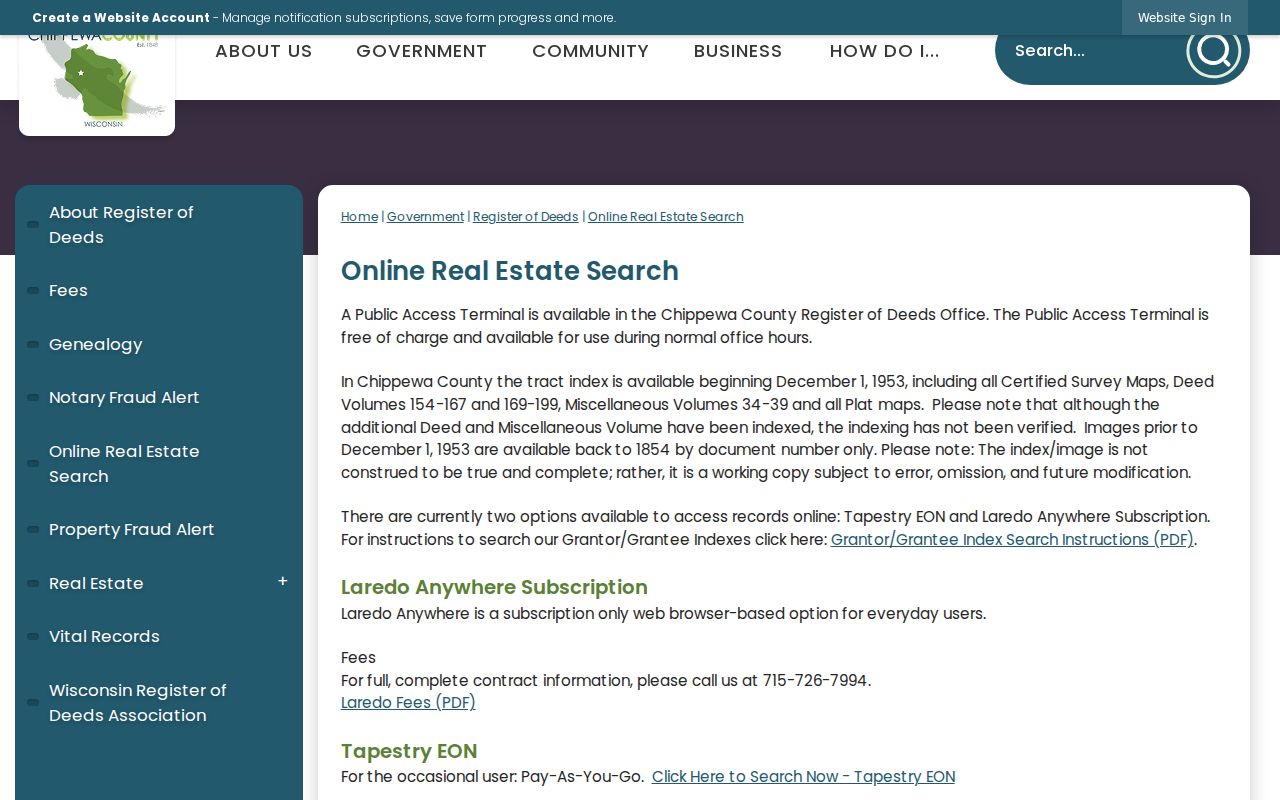
For coverage details, office-terminal access, and the current Tapestry and Laredo options, the county page is the authoritative source.
How the Chippewa Grantor-Grantee Index Works
Grantor and grantee searches run in separate directions. The historical instruction sheet tells Tapestry users to pick INDEX - GRANTOR or INDEX - GRANTEE. They then type the first letter of the surname into the Last Name field. Codes mark each block. A GRIDX code is a grantor block, and a GEIDX code is a grantee block. The year range uses hyphens, and the final letter is the surname initial. Keep in mind these are index blocks, not parcel numbers.
A chain search usually starts with the newest grantee. That deed points back to the prior grantor. Each new link gets checked against the tract description. The county's current instruction PDF carries an October 28, 2025 update.
- Find the latest instrument and confirm the parcel description and grantee.
- Read the grantor named in that deed and note its date and document number.
- Search the prior party in the correct grantor or grantee index role.
- Repeat only when the legal description continues to match the same tract.
- For pre-tract-index work, use the historical block code and then locate the image by document number.
- Grantor
- The party shown as conveying an interest.
- Grantee
- The party shown as receiving an interest.
- Chain of title
- The ordered sequence of instruments that shows transfers over time.
- Document number
- The county reference used to locate the recorded image; historic index blocks point to these numbers.
Older Chippewa Deeds by Document Number
Document images reach back to 1854. The online tract index only starts in 1953. For older deeds, find the right surname initial and year block first. The instructions give working examples. GRIDX1950-51-A marks a grantor block. GEIDX1899-1902-S marks a grantee block. Note: the 1856 grantor block is identified as a mortgage index, so it may not hold the deed you expect.
The county also warns that some initials have no entries in certain blocks. Gaps among the older records include X and some Q, Y, and U ranges. An empty block does not prove a transfer never happened. A remote search can still stall. Ask the Register of Deeds for index help or use the free office terminal.
Read each code literally. GRIDX means grantor. GEIDX means grantee. The year span and the surname initial follow. The 1856 grantor block is labeled a mortgage index. A hit there may describe a lender's interest rather than a transfer of ownership. Never carry a document into the chain until its party roles and legal description match the tract you are researching.
See the historical index search instructions for the year ranges and hyphen patterns.
The Tapestry EON search interface is the remote pay-as-you-go route for a Chippewa County deed search.
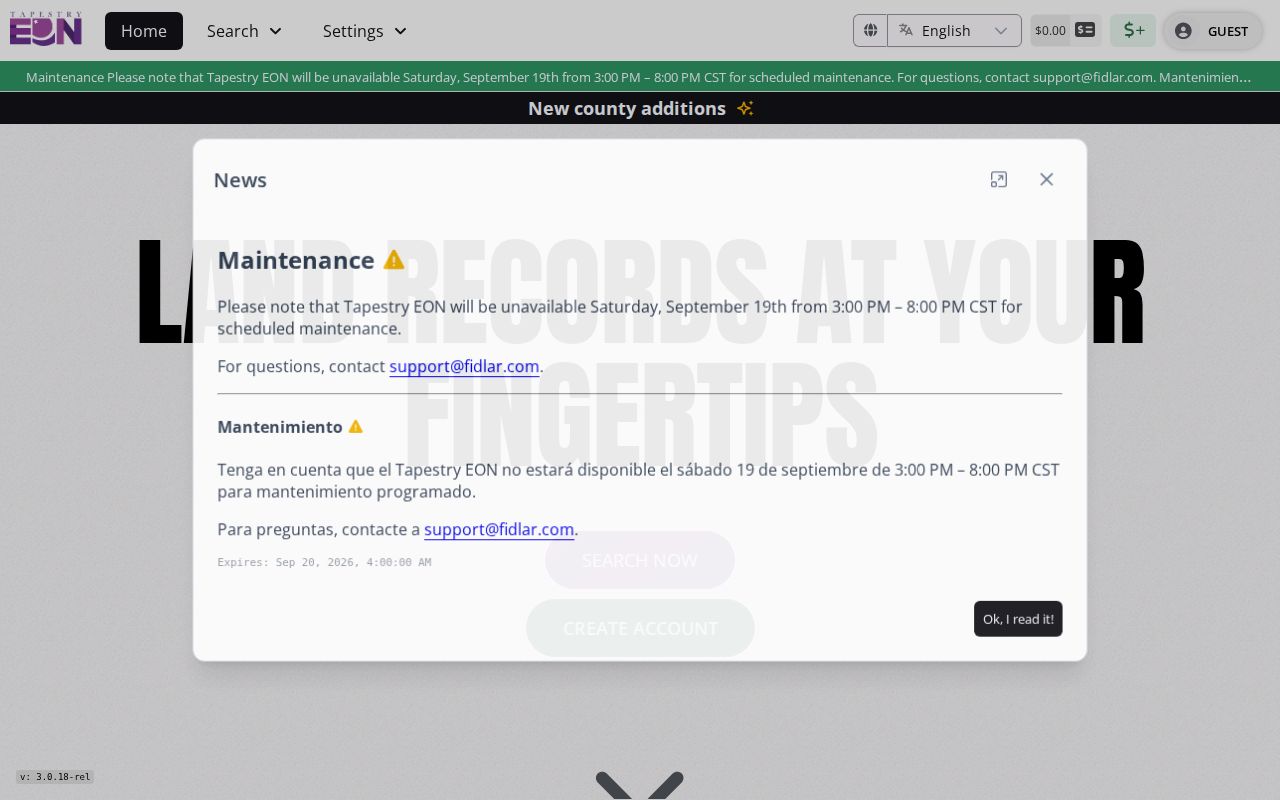
Tapestry cannot sort historical document numbers. Laredo can sort them by year, which may help when you step through an older chain.
Chippewa County Deed Search Fields
The county's published search instructions define the available controls and their limits. Live result-card labels vary, so the fields below describe what the search form supports rather than any particular sample row.
| Field or control | Type | Use | Note |
|---|---|---|---|
| DocType | Dropdown | Choose INDEX - GRANTOR or INDEX - GRANTEE | Used for historical index mode |
| Last Name / Name | Text | Enter the surname initial for old blocks | Modern criteria may be broader |
| Document Number | Text | Find a known recorded instrument | Historic patterns include a year range and initial |
| Description | Text/search mode | Search a legal description where supported | Compare wording and tract, not address alone |
| Search / Sort | Action/control | Run a query and order results | Tapestry history does not sort; Laredo can |
Search results are references, not full records. Expect indexed party role, document type, recording date, number, description, and an image link. Tapestry requires an interactive paid search, so open the document itself to confirm the details.
Chippewa Deed Search Cost and Access
Paid deed search access runs through two vendors. Tapestry bills $8.95 plus tax per search and may return up to 300 listings. Once results come back, document details are free. Printing costs $2 for the first page and $1 for each added page. Credit-card pay-as-you-go is an option. Prepay accounts run from $50 to $1,000. Laredo works on a subscription contract instead. Call the Register of Deeds at 715-726-7994 for current terms. A free public terminal sits in the Register of Deeds office during normal hours. It earns its keep when a paid search misses. An old index block can also be hard to read.
The county's online search page does not post a general certified-deed copy fee. Confirm copy and certification charges before ordering. The terminal is a route through a difficult index. It is not a substitute for a certified copy. A result may give a document number or an image reference. The printed image, the plain copy, and the certified copy can each carry its own charge. Bring a parcel description and both parties' names. Staff can then steer you to a grantor search, a grantee search, or a document-number lookup.
Chippewa Plat Names and Legal Descriptions
Chippewa County's plat reference runs 28 pages. It lists recorded names with volume, page, document number, and a short code. The code is a search aid only. It is not a parcel number. Tapestry and Laredo searches may need punctuation stripped out. Some entries also demand reordered words or parenthetical merger and removal text left off. An exact phrase may fail. So run a second pass using the recorded form plus a punctuation-free form.
Plat names appear throughout the county reference. Examples include Fox Run, Hager Addition, Hunter Ridge, South Wind Estates, and Stillson Shores. A plat name alone still proves nothing about a specific parcel. Match the image, the legal description, and the current GIS location. A CSM can split a parent parcel. A condominium unit needs its declaration and unit deed in the chain.
Chippewa County Property Fraud Alert
The county-linked Property Fraud Alert is free and name-based. Register a personal, trust, or business name with the Register of Deeds. You can do this online. You can also do it by phone. The service sends an alert whenever that name appears on a recorded document. Chippewa County records are covered this way. Limits matter, though. It does not block a filing, prove a document false, or catch every name variation.
If an alert arrives, compare the recording number and document image against the parcel record. Then contact the Register of Deeds. A name match alone does not mean the parcel transferred. Think of the alert as a prompt to review the recorded instrument. Enrollment runs through the county-linked Chippewa Property Fraud Alert service.
Getting a Chippewa County Deed Copy
For a recorded instrument, note the document number. Ask the Register of Deeds which image or certified-copy route fits. Tapestry print fees cover image pages. Certification and other copy charges belong with the office. Keep the products straight. A remote index search, a document image, a plain copy, and a certified copy are different things.
When an index result falls short, use the free courthouse terminal. You can also contact the office at 711 N Bridge Street, Room 111, Chippewa Falls, WI 54729. A written Wisconsin Public Records Law request can describe the parcel. It can also cover parties, document type, and date range. For a full ownership history rather than one copy, the former-owner chain method shows how to work back through grantor and grantee roles.
Recorded, not guaranteed. Chippewa County’s index is a working copy and may omit or misstate an entry. A recorded deed is not a complete title opinion; obtain a title search when clear ownership must be established.